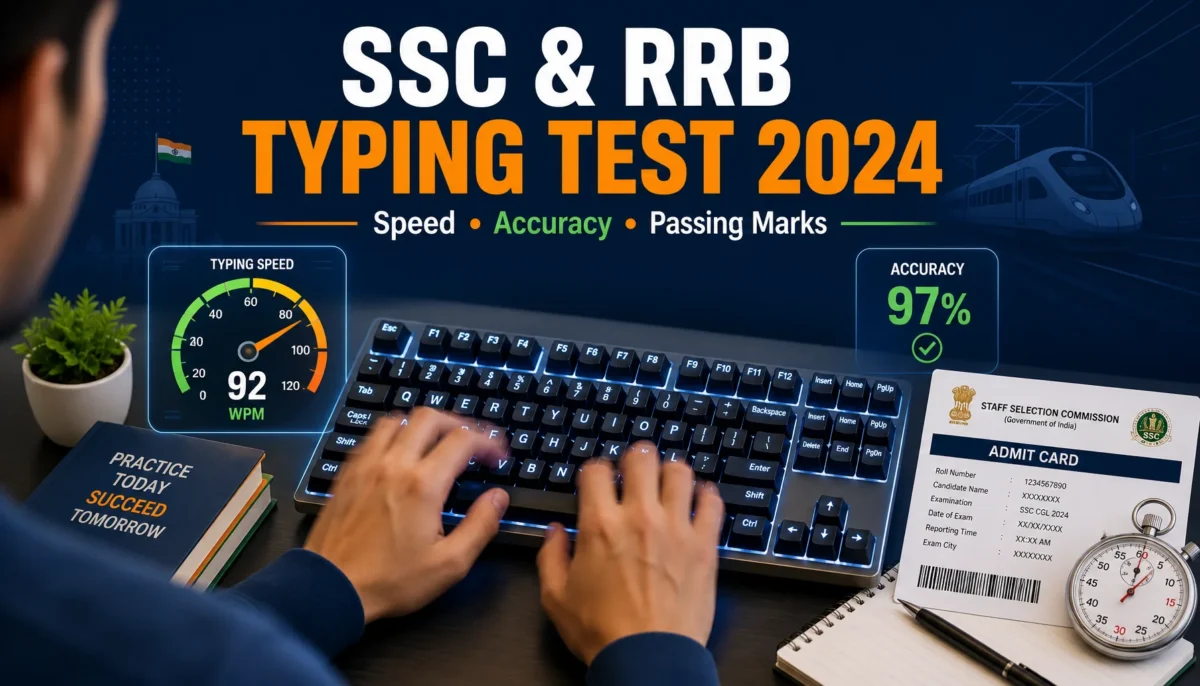
Cracking a government exam like SSC or RRB doesn’t end with clearing the written stage. For many popular posts, the final hurdle is the typing test — a skill-based examination that measures how fast and accurately you can type. Every year, thousands of candidates who ace the objective papers stumble here simply because they underestimated the typing requirements. This complete 2024 guide breaks down everything you need to know: minimum speed, accuracy standards, qualifying criteria, and how the tests differ across English and Hindi.
Why the Typing Test Matters
The typing test (also called the Typing Skill Test or Data Entry Skill Test) is a qualifying stage for several posts filled through SSC and RRB. Roles such as Lower Division Clerk (LDC), Data Entry Operator (DEO), Junior Secretariat Assistant (JSA), and various clerical positions require candidates to demonstrate practical typing proficiency.
The key thing to remember is that most typing tests are qualifying in nature — your speed and accuracy don’t add to your final merit score, but failing to meet the minimum standard will disqualify you entirely. That makes preparation non-negotiable.
SSC Typing Test Requirements
The Staff Selection Commission conducts typing tests for posts under the SSC CHSL (Combined Higher Secondary Level) and SSC CGL (Combined Graduate Level) examinations. The standards vary slightly depending on the post.
Typing Speed for SSC LDC / JSA (CHSL)
For Lower Division Clerk and Junior Secretariat Assistant roles, the typing test measures your typing speed on a computer:
- English: 35 words per minute (WPM)
- Hindi: 30 words per minute (WPM)
The 35 WPM in English corresponds to roughly 10,500 key depressions per hour, while 30 WPM in Hindi corresponds to about 9,000 key depressions per hour. Candidates get a passage of around 2,000 key depressions to type within 10 minutes.
Data Entry Speed for SSC DEO (CGL)
For Data Entry Operator posts, the requirement is measured in key depressions rather than words:
- DEO (general): 8,000 key depressions per hour
- DEO Grade ‘A’: 15,000 key depressions per hour on a computer
The DEO skill test is more demanding and typically involves typing a passage displayed on screen within a fixed time frame of about 15 minutes.
RRB Typing Test Requirements
The Railway Recruitment Board conducts typing skill tests primarily for posts under the NTPC (Non-Technical Popular Categories) category, such as Junior Clerk cum Typist, Accounts Clerk cum Typist, and Senior Clerk cum Typist.
The RRB typing standard is generally:
- English: 30 words per minute (WPM)
- Hindi: 25 words per minute (WPM)
Important notes about the RRB test:
- It is a qualifying test — marks are not counted for the final merit list.
- Candidates must type either in English or Hindi, not both.
- Editing tools like spell check are usually disabled.
- The test is conducted on a personal computer without any special typing software assistance.
Understanding Accuracy vs. Speed
Many candidates obsess over raw speed and forget that accuracy is equally critical. In most typing tests, errors are penalized, which can drag your effective speed below the qualifying threshold even if you type fast.
Here’s how it typically works:
- Full mistakes: Wrong words, extra words, or omitted words.
- Half mistakes: Spelling errors, spacing errors, or capitalization mistakes.
The general recommendation is to maintain an accuracy of 92% or higher. Typing at 40 WPM with 80% accuracy is worse than typing at 35 WPM with 95% accuracy. The goal is to strike a balance where you’re fast enough to comfortably exceed the minimum while keeping errors low.
How the Net Speed Is Calculated
Understanding the scoring math helps you set realistic targets. A simplified formula for net speed is:
Net Speed = Gross Speed − (Errors ÷ Total Time in Minutes)
For example, if you type 350 words in 10 minutes (35 gross WPM) but make 20 errors, your penalty is 2 WPM, giving you a net speed of 33 WPM. This might fall short of the 35 WPM English requirement, which is why error control is essential.
English vs. Hindi Typing: Key Differences
Choosing between English and Hindi depends on your comfort and the keyboard layout you’ve practiced with.
- English typing uses the standard QWERTY keyboard, which most candidates are already familiar with.
- Hindi typing can be done using layouts like Mangal (InScript) or Krutidev (Remington). The InScript layout is increasingly used in government tests since it’s the standardized Unicode option.
If you opt for Hindi, invest time in memorizing the layout thoroughly, as the key positions differ significantly from English.
Practical Tips to Pass the Typing Test
Consistent, focused practice is the surest way to clear the typing test. Here are proven strategies:
- Practice daily: Dedicate at least 30–45 minutes every day. Consistency beats occasional long sessions.
- Use the correct layout: Practice on the exact keyboard and layout used in the actual exam.
- Focus on accuracy first: Build clean typing habits before pushing for speed.
- Take mock tests: Simulate the 10-minute exam environment to build stamina and manage nerves.
- Learn touch typing: Typing without looking at the keyboard dramatically improves both speed and accuracy.
- Avoid the backspace trap: Constantly correcting minor errors wastes time — learn to type cleanly the first time.
Common Mistakes to Avoid
- Practicing only speed while ignoring error rates.
- Not practicing on the official layout (e.g., using Krutidev when the exam uses Mangal).
- Skipping mock tests and underestimating exam-day pressure.
- Forgetting to check whether the exam allows editing keys.
Conclusion
The SSC notification sarkari and RRB typing tests are entirely conquerable with disciplined preparation. Whether you’re aiming for 35 WPM in English or 30 WPM in Hindi, the winning formula is simple: build strong touch-typing fundamentals, prioritize accuracy, and simulate real exam conditions through regular mock tests. Since these tests are qualifying, clearing them is a pass/fail matter — so leave nothing to chance. Start practicing today, track your progress weekly, and walk into your typing test with the confidence to secure your government job.