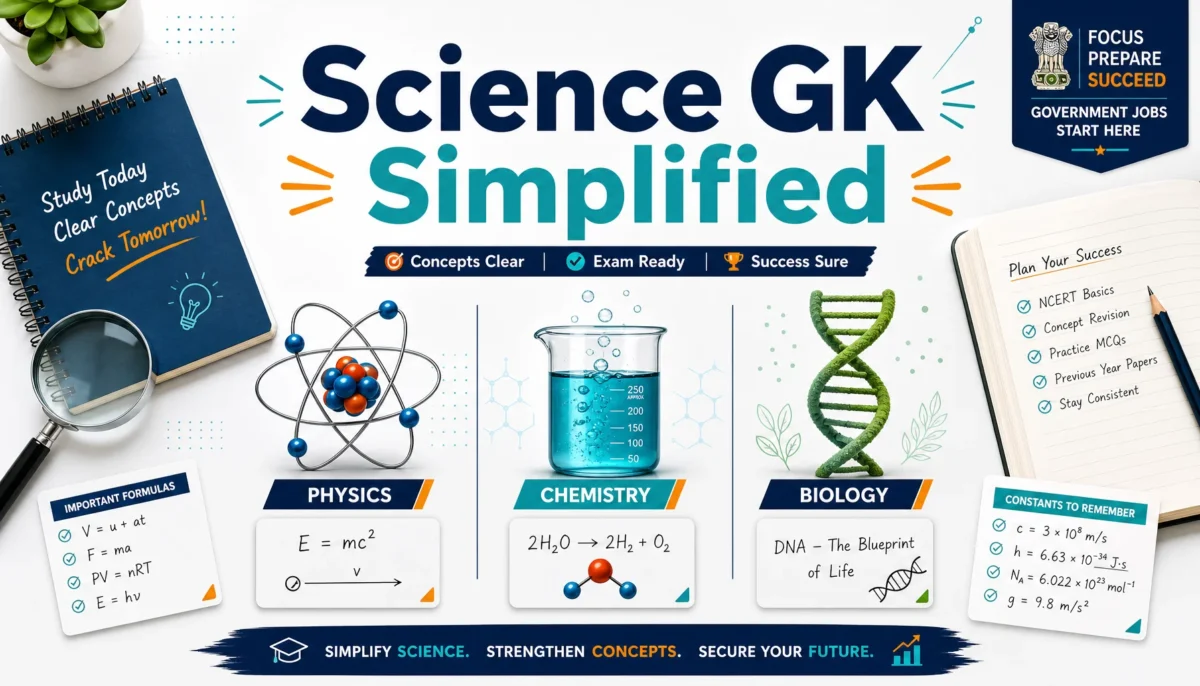
If you’re preparing for competitive exams or entrance tests, you already know that science-based general knowledge questions can make or break your score. The good news? You don’t need a science degree to answer these questions correctly. Most of them test fundamental concepts that, once understood in simple terms, become surprisingly easy to remember. This guide breaks down key Physics, Chemistry, and Biology questions into plain, digestible explanations designed especially for non-science students.online preparation
Let’s simplify science and turn one of your weakest sections into a scoring opportunity.
Why Science GK Matters in Competitive Exams
Science questions appear frequently in exams like SSC, UPSC, banking, railways, state PSCs, and various entrance tests. Examiners love them because they test both memory and basic reasoning. Unlike deep technical questions, most science GK items focus on everyday phenomena, famous discoveries, units, and simple facts.
Here’s the encouraging part: with a little strategic learning, even students from arts or commerce backgrounds can master these topics. The trick is understanding the “why” behind each fact instead of blindly memorizing it.
Physics Made Simple
Physics is all about how the world moves, works, and behaves. Many exam questions revolve around common laws, units, and natural phenomena you experience every day.calculate age
Commonly Asked Physics Questions
- Why does the sky appear blue? Sunlight scatters when it hits the atmosphere. Blue light scatters more than other colors because it travels in shorter waves. This is called Rayleigh scattering.
- What is the SI unit of force? The Newton (N). Think of Newton every time you push or pull something.
- Why do we see lightning before hearing thunder? Light travels faster than sound. So light reaches your eyes almost instantly, while sound takes longer.
- What keeps satellites in orbit? A balance between gravity pulling them inward and their forward motion. This continuous “falling around” the Earth keeps them in orbit.
Quick Physics Facts to Memorize
- Speed of light: approximately 3 × 10⁸ meters per second.
- The unit of electric current is the Ampere.
- Energy is measured in Joules.
- A device that measures atmospheric pressure is a barometer.
- The mirror used in vehicle side-view mirrors is a convex mirror because it gives a wider view.
Chemistry Without the Confusion
Chemistry deals with what things are made of and how they react. Many students fear it, but exam questions usually focus on elements, everyday chemicals, and simple reactions.
Popular Chemistry Questions
- What is the chemical formula for water? H₂O — two hydrogen atoms and one oxygen atom.
- Which gas do plants release during photosynthesis? Oxygen. This is why plants are essential for life on Earth.
- What is common salt chemically known as? Sodium Chloride (NaCl).
- Why does an apple turn brown when cut? Because it reacts with oxygen in the air — a process called oxidation.
Essential Chemistry Facts
- The most abundant gas in the atmosphere is Nitrogen (about 78%).
- The lightest element is Hydrogen.
- Gold’s chemical symbol is Au, and silver’s is Ag.
- Baking soda is chemically Sodium Bicarbonate.
- The pH value of pure water is 7 (neutral). Below 7 is acidic, above 7 is basic.
Memory tip: Learn chemical symbols by linking them to their Latin or original names. For example, “Au” for gold comes from the Latin word aurum.
Biology You Can Actually Enjoy
Biology is the study of living things, and it’s often the most relatable science section because it’s about your own body, plants, and animals.
Frequently Asked Biology Questions
- What is the powerhouse of the cell? The Mitochondria — it produces energy for the cell.
- Which organ purifies our blood? The Kidneys filter waste from the blood.
- How many bones are in the adult human body? 206 bones.
- What pigment makes leaves green? Chlorophyll, which helps plants make food through photosynthesis.
Key Biology Facts to Remember
- The largest organ in the human body is the skin.
- The human heart has four chambers.
- The study of birds is called ornithology.
- Red blood cells are produced in the bone marrow.
- Vitamin D is produced when your skin is exposed to sunlight.
Smart Strategies to Score in Science GK
Understanding facts is only half the battle. Here’s how to retain them and use them effectively during exams:
- Connect facts to daily life. When you understand why the sky is blue or why iron rusts, you’re far more likely to remember it.
- Use flashcards. Write a question on one side and the answer on the other. Review them daily for quick recall.
- Group similar topics. Study all units together, all chemical symbols together, and all body organs together to build strong associations.
- Practice previous year questions. Many science GK questions repeat across exams. Solving past papers reveals patterns.
- Teach someone else. Explaining a concept in simple words helps lock it into your memory.
Common Mistakes to Avoid
Non-science students often lose marks due to avoidable errors. Keep these in mind:
- Don’t confuse similar units, like the Newton (force) and Joule (energy).
- Avoid mixing up chemical symbols — Na is sodium, not nitrogen (N).
- Remember that not all gases we breathe are oxygen; nitrogen dominates the air.
- Don’t ignore basic diagrams. Understanding a simple picture of the human heart or a plant cell can answer many questions.
Conclusion
Science GK doesn’t have to be intimidating. When you break it into simple, relatable concepts, Physics, Chemistry, and Biology become an easy source of marks rather than a stumbling block. Focus on understanding the logic behind each fact, connect it to everyday experiences, and practice consistently.typing speed
Whether you’re an arts, commerce, or non-science student, mastering these fundamental questions can significantly boost your competitive exam score. Start with the basics, revise regularly, and watch your confidence grow. Science, after all, is just the study of the world around you — and you already know more of it than you think.

About the Author
saritha
Professional content writer with two years of experience in government job content. He provides accurate and timely updates on SSC, UPSC, Banking, Railways, and State PSC notifications, admit cards, answer keys, and results for aspirants across India.
