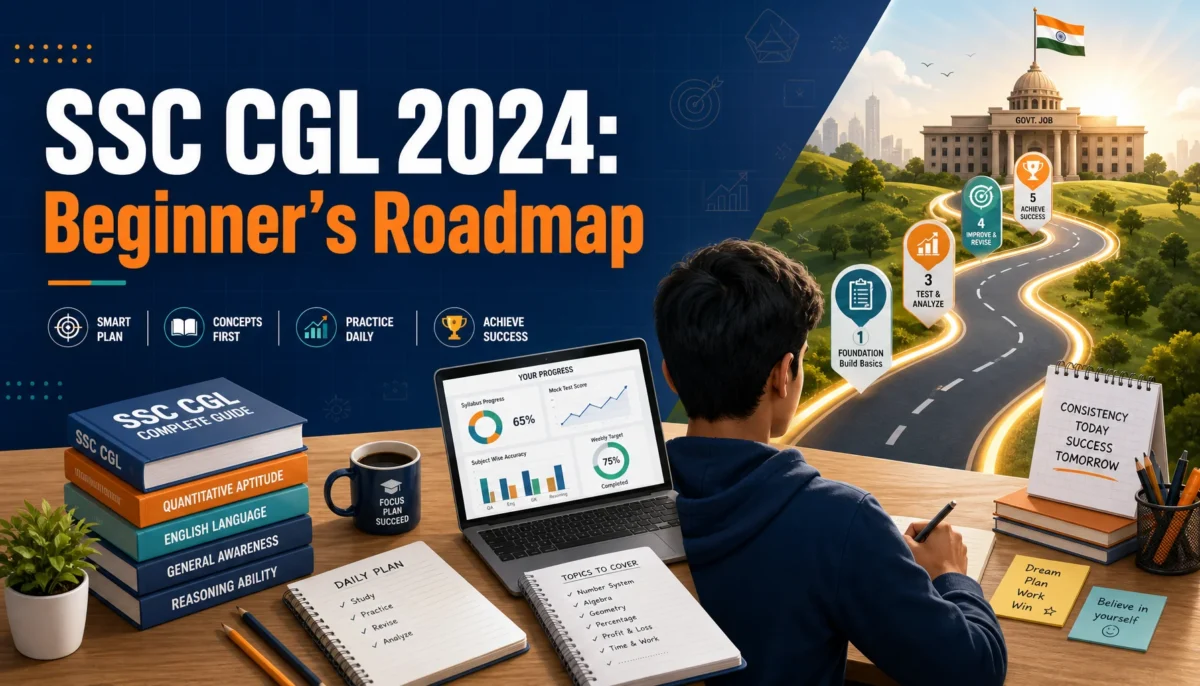
So you’ve decided to crack the SSC CGL exam and land a coveted government job—but you don’t know where to begin. Maybe you’ve heard the exam is tough, the syllabus is vast, and the competition is fierce. All of that is true, but here’s the good news: with the right roadmap and consistent effort, you can prepare entirely online, from the comfort of your home, without spending a fortune on coaching. This guide is built specifically for first-time aspirants who are starting from scratch in 2024. Let’s break it all down, step by step.typing test 2024
What Is SSC CGL and Why Should You Care?
The Staff Selection Commission Combined Graduate Level (SSC CGL) examination is one of India’s most popular competitive exams. It recruits candidates for Group B and Group C posts across various ministries, departments, and organizations of the Government of India. Think roles like Income Tax Inspector, Assistant Section Officer, Auditor, Excise Inspector, and many more.
Why is it so sought-after? Job security, attractive pay scales, respect, and steady career growth. If you’re a graduate (or in your final year), you’re eligible to appear—making it accessible to millions of aspirants every year.
Understanding the Exam Structure
Before you dive into books and videos, you need to understand exactly what you’re preparing for. The SSC CGL exam is conducted in multiple stages, called Tiers.ssc exam
Tier 1 – The Screening Round
This is a computer-based objective test that acts as a qualifying and screening round. It covers four sections:
- General Intelligence & Reasoning – 25 questions, 50 marks
- General Awareness – 25 questions, 50 marks
- Quantitative Aptitude – 25 questions, 50 marks
- English Comprehension – 25 questions, 50 marks
You get 60 minutes to answer 100 questions worth 200 marks. Remember: there’s negative marking of 0.50 marks for each wrong answer, so guesswork can hurt you.
Tier 2 – The Main Exam
This is where your fate is truly decided. Tier 2 is more detailed and consists of multiple papers covering Mathematical Abilities, Reasoning, English, General Awareness, Computer Knowledge, and a Data Entry Speed Test (for certain posts). The scores from Tier 2 are used to prepare the final merit list.
Breaking Down the Syllabus
The syllabus can feel overwhelming at first glance, but once you break it into digestible chunks, it becomes manageable. Here’s a quick overview of each subject.calculate age
Quantitative Aptitude
This section tests your mathematical skills. Key topics include:
- Number systems, percentages, ratio and proportion
- Profit and loss, simple and compound interest
- Time, speed, distance, and work
- Algebra, geometry, trigonometry, and mensuration
- Data interpretation
General Intelligence & Reasoning
Expect questions on analogies, coding-decoding, series, blood relations, syllogisms, puzzles, and figure-based problems. This is often the most scoring section if you practice regularly.
English Comprehension
Grammar, vocabulary, sentence correction, reading comprehension, synonyms, antonyms, idioms, and cloze tests dominate this section. Building a strong vocabulary habit early pays off enormously.
General Awareness
This covers history, geography, polity, economics, general science, and current affairs. It’s the least time-consuming during the exam (no calculations), but it demands consistent daily reading.
How to Start Preparing Online from Scratch
Now for the part you’ve been waiting for—the actual roadmap. Follow these steps in order and you’ll build a strong foundation.
Step 1: Gather the Right Study Material
You don’t need to buy a mountain of books. Start with a few quality resources:
- Free YouTube channels dedicated to SSC preparation
- Standard books for Quant, Reasoning, and English (digital or physical)
- A daily current affairs app or website
- One reliable online mock test platform
Step 2: Create a Realistic Study Schedule
Consistency beats intensity. Instead of studying 10 hours one day and skipping the next three, aim for 4–6 focused hours daily. Divide your time across all four subjects so no section gets neglected. A sample daily plan might look like:
- 1.5 hours – Quantitative Aptitude
- 1 hour – Reasoning
- 1 hour – English
- 45 minutes – General Awareness and current affairs
- 45 minutes – Revision and practice questions
Step 3: Learn Concepts Before Practicing
Don’t jump straight into solving hundreds of questions without understanding the underlying concepts. Watch topic-wise video lectures, take notes, and only then attempt problems. This builds accuracy rather than just speed.
Step 4: Make Notes and Formula Sheets
Keep separate digital or physical notebooks for formulas, grammar rules, and important current affairs. These become your quick-revision gold mine in the final weeks before the exam.
Step 5: Practice with Mock Tests
Mock tests are non-negotiable. They help you manage time, get comfortable with the computer-based format, and identify weak areas. Start with sectional tests, then move to full-length mocks. After every test, analyze your mistakes thoroughly—this analysis is where real improvement happens.
Smart Tips for Effective Online Preparation
Preparing online offers flexibility, but it also brings distractions. Here’s how to stay on track:
- Minimize distractions: Use website blockers and keep your phone in another room during study hours.
- Join a community: Online forums and Telegram groups keep you motivated and updated on exam news.
- Track your progress: Maintain a simple spreadsheet to monitor topics covered and mock scores.
- Revise weekly: Dedicate one day a week solely to revising what you learned.
- Prioritize weak areas: Spend extra time on topics where your accuracy is low.
Common Mistakes First-Timers Should Avoid
Learning from others’ errors saves you time. Steer clear of these pitfalls:
- Collecting too many resources and never finishing any of them
- Ignoring negative marking and guessing blindly
- Neglecting revision in favor of learning new topics constantly
- Skipping mock test analysis
- Comparing your progress obsessively with others
Conclusion
Cracking SSC CGL 2024 is entirely achievable with a clear plan, quality online resources, and disciplined consistency. Start by understanding the exam structure, break the syllabus into manageable parts, follow a realistic daily schedule, and let mock tests guide your improvement. Remember, thousands of successful candidates began exactly where you are now—confused and unsure but determined. Take the first step today, stay consistent, and your government job dream can become reality. Good luck!

About the Author
muraliprasad
A dedicated content writer specializing in government job notifications and results. With two years of experience covering SSC, UPSC, Banking, Railways, and State PSC examinations, he delivers reliable, well-researched updates tailored for serious government job aspirants.
