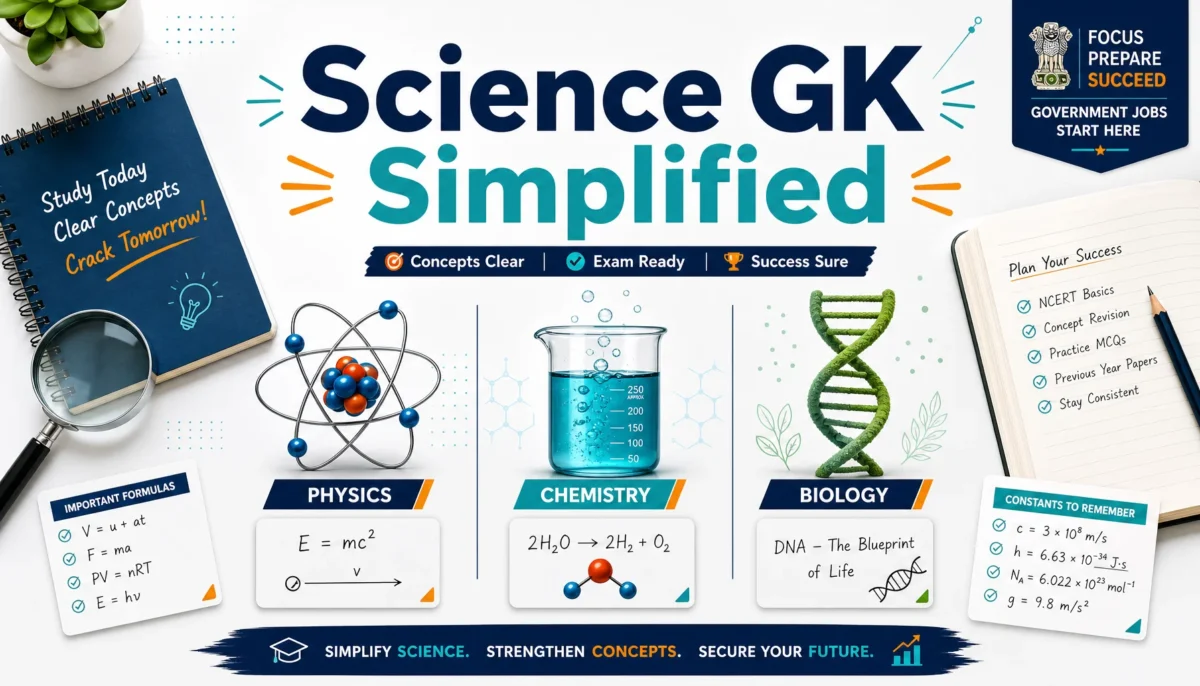
Science GK for Competitive Exams: Physics, Chemistry, and Biology Questions Simplified

If you’re preparing for competitive exams or entrance tests, you already know that science-based general knowledge questions can make or break your score. The good news? You don’t need a science degree to answer these questions correctly. Most of them test fundamental concepts that, once understood in simple terms, become surprisingly easy to remember. This guide breaks down key Physics, Chemistry, and Biology questions into plain, digestible explanations designed especially for non-science students.

Let’s simplify science and turn one of your weakest sections into a scoring opportunity.

Why Science GK Matters in Competitive Exams

Science questions appear frequently in exams like SSC, UPSC, banking, railways, state PSCs, and various entrance tests. Examiners love them because they test both memory and basic reasoning. Unlike deep technical questions, most science GK items focus on everyday phenomena, famous discoveries, units, and simple facts.

Here’s the encouraging part: with a little strategic learning, even students from arts or commerce backgrounds can master these topics. The trick is understanding the “why” behind each fact instead of blindly memorizing it.

Physics Made Simple

Physics is all about how the world moves, works, and behaves. Many exam questions revolve around common laws, units, and natural phenomena you experience every day.

Commonly Asked Physics Questions

  • Why does the sky appear blue? Sunlight scatters when it hits the atmosphere. Blue light scatters more than other colors because it travels in shorter waves. This is called Rayleigh scattering.
  • What is the SI unit of force? The Newton (N). Think of Newton every time you push or pull something.
  • Why do we see lightning before hearing thunder? Light travels faster than sound. So light reaches your eyes almost instantly, while sound takes longer.
  • What keeps satellites in orbit? A balance between gravity pulling them inward and their forward motion. This continuous “falling around” the Earth keeps them in orbit.

Quick Physics Facts to Memorize

  • Speed of light: approximately 3 × 10⁸ meters per second.
  • The unit of electric current is the Ampere.
  • Energy is measured in Joules.
  • A device that measures atmospheric pressure is a barometer.
  • The mirror used in vehicle side-view mirrors is a convex mirror because it gives a wider view.

Chemistry Without the Confusion

Chemistry deals with what things are made of and how they react. Many students fear it, but exam questions usually focus on elements, everyday chemicals, and simple reactions.

Popular Chemistry Questions

  • What is the chemical formula for water? H₂O — two hydrogen atoms and one oxygen atom.
  • Which gas do plants release during photosynthesis? Oxygen. This is why plants are essential for life on Earth.
  • What is common salt chemically known as? Sodium Chloride (NaCl).
  • Why does an apple turn brown when cut? Because it reacts with oxygen in the air — a process called oxidation.

Essential Chemistry Facts

  • The most abundant gas in the atmosphere is Nitrogen (about 78%).
  • The lightest element is Hydrogen.
  • Gold’s chemical symbol is Au, and silver’s is Ag.
  • Baking soda is chemically Sodium Bicarbonate.
  • The pH value of pure water is 7 (neutral). Below 7 is acidic, above 7 is basic.

Memory tip: Learn chemical symbols by linking them to their Latin or original names. For example, “Au” for gold comes from the Latin word aurum.

Biology You Can Actually Enjoy

Biology is the study of living things, and it’s often the most relatable science section because it’s about your own body, plants, and animals.

Frequently Asked Biology Questions

  • What is the powerhouse of the cell? The Mitochondria — it produces energy for the cell.
  • Which organ purifies our blood? The Kidneys filter waste from the blood.
  • How many bones are in the adult human body? 206 bones.
  • What pigment makes leaves green? Chlorophyll, which helps plants make food through photosynthesis.

Key Biology Facts to Remember

  • The largest organ in the human body is the skin.
  • The human heart has four chambers.
  • The study of birds is called ornithology.
  • Red blood cells are produced in the bone marrow.
  • Vitamin D is produced when your skin is exposed to sunlight.

Smart Strategies to Score in Science GK

Understanding facts is only half the battle. Here’s how to retain them and use them effectively during exams:

  • Connect facts to daily life. When you understand why the sky is blue or why iron rusts, you’re far more likely to remember it.
  • Use flashcards. Write a question on one side and the answer on the other. Review them daily for quick recall.
  • Group similar topics. Study all units together, all chemical symbols together, and all body organs together to build strong associations.
  • Practice previous year questions. Many science GK questions repeat across exams. Solving past papers reveals patterns.
  • Teach someone else. Explaining a concept in simple words helps lock it into your memory.

Common Mistakes to Avoid

Non-science students often lose marks due to avoidable errors. Keep these in mind:

  • Don’t confuse similar units, like the Newton (force) and Joule (energy).
  • Avoid mixing up chemical symbols — Na is sodium, not nitrogen (N).
  • Remember that not all gases we breathe are oxygen; nitrogen dominates the air.
  • Don’t ignore basic diagrams. Understanding a simple picture of the human heart or a plant cell can answer many questions.

Conclusion

Science GK doesn’t have to be intimidating. When you break it into simple, relatable concepts, Physics, Chemistry, and Biology become an easy source of marks rather than a stumbling block. Focus on understanding the logic behind each fact, connect it to everyday experiences, and practice consistently.

Whether you’re an arts, commerce, or non-science student, mastering these fundamental questions can significantly boost your competitive exam score. Start with the basics, revise regularly, and watch your confidence grow. Science, after all, is just the study of the world around you — and you already know more of it than you think.
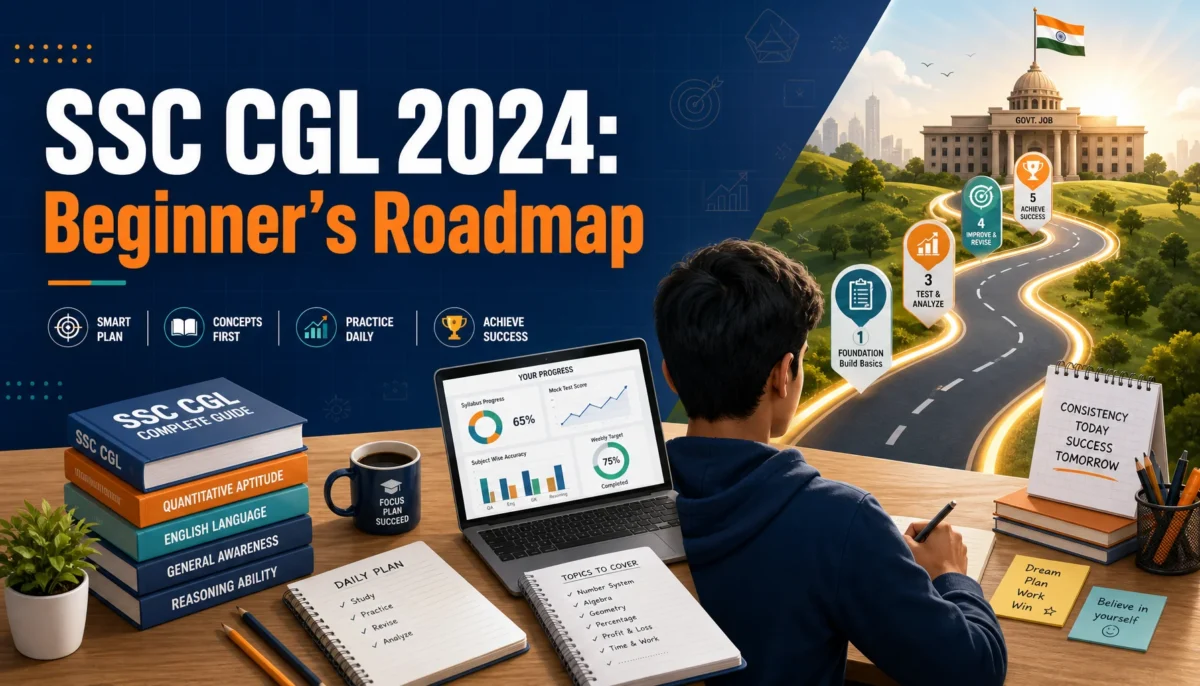

SSC CGL Online Preparation 2026: The Complete Beginner’s Roadmap

So you’ve decided to crack the SSC CGL exam and land a coveted government job—but you don’t know where to begin. Maybe you’ve heard the exam is tough, the syllabus is vast, and the competition is fierce. All of that is true, but here’s the good news: with the right roadmap and consistent effort, you can prepare entirely online, from the comfort of your home, without spending a fortune on coaching. This guide is built specifically for first-time aspirants who are starting from scratch in 2024. Let’s break it all down, step by step.

What Is SSC CGL and Why Should You Care?

The Staff Selection Commission Combined Graduate Level (SSC CGL) examination is one of India’s most popular competitive exams. It recruits candidates for Group B and Group C posts across various ministries, departments, and organizations of the Government of India. Think roles like Income Tax Inspector, Assistant Section Officer, Auditor, Excise Inspector, and many more.

Why is it so sought-after? Job security, attractive pay scales, respect, and steady career growth. If you’re a graduate (or in your final year), you’re eligible to appear—making it accessible to millions of aspirants every year.

Understanding the Exam Structure

Before you dive into books and videos, you need to understand exactly what you’re preparing for. The SSC CGL exam is conducted in multiple stages, called Tiers.

Tier 1 – The Screening Round

This is a computer-based objective test that acts as a qualifying and screening round. It covers four sections:

  • General Intelligence & Reasoning – 25 questions, 50 marks
  • General Awareness – 25 questions, 50 marks
  • Quantitative Aptitude – 25 questions, 50 marks
  • English Comprehension – 25 questions, 50 marks

You get 60 minutes to answer 100 questions worth 200 marks. Remember: there’s negative marking of 0.50 marks for each wrong answer, so guesswork can hurt you.

Tier 2 – The Main Exam

This is where your fate is truly decided. Tier 2 is more detailed and consists of multiple papers covering Mathematical Abilities, Reasoning, English, General Awareness, Computer Knowledge, and a Data Entry Speed Test (for certain posts). The scores from Tier 2 are used to prepare the final merit list.

Breaking Down the Syllabus

The syllabus can feel overwhelming at first glance, but once you break it into digestible chunks, it becomes manageable. Here’s a quick overview of each subject.

Quantitative Aptitude

This section tests your mathematical skills. Key topics include:

  • Number systems, percentages, ratio and proportion
  • Profit and loss, simple and compound interest
  • Time, speed, distance, and work
  • Algebra, geometry, trigonometry, and mensuration
  • Data interpretation

General Intelligence & Reasoning

Expect questions on analogies, coding-decoding, series, blood relations, syllogisms, puzzles, and figure-based problems. This is often the most scoring section if you practice regularly.

English Comprehension

Grammar, vocabulary, sentence correction, reading comprehension, synonyms, antonyms, idioms, and cloze tests dominate this section. Building a strong vocabulary habit early pays off enormously.

General Awareness

This covers history, geography, polity, economics, general science, and current affairs. It’s the least time-consuming during the exam (no calculations), but it demands consistent daily reading.

How to Start Preparing Online from Scratch

Now for the part you’ve been waiting for—the actual roadmap. Follow these steps in order and you’ll build a strong foundation.

Step 1: Gather the Right Study Material

You don’t need to buy a mountain of books. Start with a few quality resources:

  • Free YouTube channels dedicated to SSC preparation
  • Standard books for Quant, Reasoning, and English (digital or physical)
  • A daily current affairs app or website
  • One reliable online mock test platform

Step 2: Create a Realistic Study Schedule

Consistency beats intensity. Instead of studying 10 hours one day and skipping the next three, aim for 4–6 focused hours daily. Divide your time across all four subjects so no section gets neglected. A sample daily plan might look like:

  • 1.5 hours – Quantitative Aptitude
  • 1 hour – Reasoning
  • 1 hour – English
  • 45 minutes – General Awareness and current affairs
  • 45 minutes – Revision and practice questions

Step 3: Learn Concepts Before Practicing

Don’t jump straight into solving hundreds of questions without understanding the underlying concepts. Watch topic-wise video lectures, take notes, and only then attempt problems. This builds accuracy rather than just speed.

Step 4: Make Notes and Formula Sheets

Keep separate digital or physical notebooks for formulas, grammar rules, and important current affairs. These become your quick-revision gold mine in the final weeks before the exam.

Step 5: Practice with Mock Tests

Mock tests are non-negotiable. They help you manage time, get comfortable with the computer-based format, and identify weak areas. Start with sectional tests, then move to full-length mocks. After every test, analyze your mistakes thoroughly—this analysis is where real improvement happens.

Smart Tips for Effective Online Preparation

Preparing online offers flexibility, but it also brings distractions. Here’s how to stay on track:

  • Minimize distractions: Use website blockers and keep your phone in another room during study hours.
  • Join a community: Online forums and Telegram groups keep you motivated and updated on exam news.
  • Track your progress: Maintain a simple spreadsheet to monitor topics covered and mock scores.
  • Revise weekly: Dedicate one day a week solely to revising what you learned.
  • Prioritize weak areas: Spend extra time on topics where your accuracy is low.

Common Mistakes First-Timers Should Avoid

Learning from others’ errors saves you time. Steer clear of these pitfalls:

  • Collecting too many resources and never finishing any of them
  • Ignoring negative marking and guessing blindly
  • Neglecting revision in favor of learning new topics constantly
  • Skipping mock test analysis
  • Comparing your progress obsessively with others

Conclusion

Cracking SSC CGL 2024 is entirely achievable with a clear plan, quality online resources, and disciplined consistency. Start by understanding the exam structure, break the syllabus into manageable parts, follow a realistic daily schedule, and let mock tests guide your improvement. Remember, thousands of successful candidates began exactly where you are now—confused and unsure but determined. Take the first step today, stay consistent, and your government job dream can become reality. Good luck!

How to Prepare Current Affairs for Competitive Exams: A 30-Day Study Plan

Current affairs can make or break your performance in competitive exams. Whether you’re preparing for civil services, banking, SSC, or state-level tests, staying updated with national and international events is non-negotiable. Yet many aspirants struggle—not because they lack information, but because they lack a system. Random reading, forgotten facts, and last-minute cramming rarely work. What you need is a structured, repeatable habit that turns overwhelming news into organized, revisable knowledge.

This 30-day study plan breaks the process into manageable phases. By the end, you’ll have built a sustainable current affairs routine, identified trustworthy sources, mastered note-taking, and revised strategically for test day. Let’s get started.

Why a Structured Approach Matters

Current affairs is a moving target. New events happen daily, and exam questions often test both recent developments and their background context. Without a plan, you’ll drown in headlines and retain very little. A structured approach helps you:

  • Filter noise from exam-relevant information
  • Build long-term retention through spaced revision
  • Cover a broad range of topics systematically
  • Reduce anxiety in the final days before the exam

Phase 1: Days 1–5 — Build the Foundation

The first five days are about setting up your system and forming a habit. Don’t rush to memorize everything—focus on establishing the right infrastructure.

Choose Reliable Sources

Quality beats quantity. Pick two or three dependable sources and stick with them instead of jumping between dozens of websites. Recommended options include:

  • A national newspaper (for editorials and in-depth coverage)
  • One monthly current affairs magazine (for consolidated summaries)
  • A trusted online current affairs portal or app (for daily quizzes and updates)
  • Official government sources like Press Information Bureau (PIB) for schemes and policies

Set Up Your Note System

Decide whether you’ll use a physical notebook or a digital tool. Create categories such as Polity, Economy, International Relations, Science & Technology, Environment, Sports, and Awards. This categorization makes revision faster and helps you spot patterns.

Phase 2: Days 6–20 — Daily Consumption and Note-Taking

This is the core of your plan. For 15 days, commit to a consistent daily routine that combines reading, note-taking, and light testing.

The Daily 60-Minute Routine

  • 20 minutes: Read the newspaper or your primary source, focusing on national, international, economic, and policy news.
  • 20 minutes: Write concise notes—not full paragraphs, but crisp bullet points with key facts, dates, names, and figures.
  • 10 minutes: Take a short current affairs quiz to test recall.
  • 10 minutes: Quickly revise the previous day’s notes.

Smart Note-Taking Tips

Effective notes are short and scannable. Follow these principles:

  • Write only exam-relevant facts—avoid copying entire articles.
  • Use a “who, what, when, where, why” format for events.
  • Highlight names of people, places, schemes, and organizations.
  • Add context: don’t just note a new policy, note the problem it solves.
  • Keep a separate page for static-linked facts (e.g., a summit’s host country and its capital).

Connect Current Events to Static Knowledge

Exams love questions that blend current affairs with static general knowledge. When you read about an international summit, revise the member countries. When a new economic report is released, brush up on related terms. This integration deepens understanding and improves recall.

Phase 3: Days 21–25 — Consolidation

By now you have three weeks of notes. This phase is about tightening your knowledge and filling gaps rather than consuming more new content.

Review Monthly Compilations

Read through a monthly current affairs compilation to catch anything you may have missed. Compare it against your own notes and add missing points. This cross-checking ensures comprehensive coverage.

daily current affairs Quiz

Create Quick-Revision Sheets

Condense your detailed notes into one-page summaries per category. Think of these as cheat sheets containing only the most important, high-frequency facts:

  • Important government schemes and their objectives
  • Key appointments and resignations
  • Awards and honors with recipients
  • Major reports, indices, and rankings
  • Sports events, winners, and venues
  • International summits and agreements

Phase 4: Days 26–30 — Revision and Testing

The final stretch is all about reinforcing memory and simulating exam conditions. Resist the urge to learn new material now—focus on locking in what you already know.

Practice with Mock Tests and Quizzes

Take a full-length current affairs quiz every day. Analyze your mistakes carefully: for each wrong answer, revisit the topic and reinforce the correct fact. Tracking your error patterns tells you exactly where to focus.

Use Active Recall and Spaced Repetition

Instead of passively rereading notes, quiz yourself. Cover your revision sheet and try to recall the facts from memory. Revisit challenging topics at increasing intervals—this spacing dramatically improves long-term retention.

Final Day Strategy

On day 30, do a light, confidence-building review. Skim your one-page summaries, avoid new sources, and get plenty of rest. Walking into the exam calm and organized is worth more than cramming a few extra facts.

mock test live

Common Mistakes to Avoid

  • Following too many sources: This leads to information overload and duplication.
  • Passive reading without notes: You’ll forget most of what you read within days.
  • Skipping revision: Reading once is never enough for retention.
  • Ignoring the “why”: Memorizing facts without context makes application questions harder.
  • Cramming at the end: Consistency beats last-minute panic every time.

Conclusion

Preparing current affairs isn’t about reading more—it’s about reading smarter. This 30-day plan works because it balances daily consumption with structured note-taking, consolidation, and disciplined revision. Build the habit early, trust your sources, keep your notes crisp, and test yourself relentlessly. Do this consistently, and you’ll walk into your exam with confidence, ready to tackle even the trickiest current affairs questions. Start today, stay consistent, and let the system do the heavy lifting.